
99%
of FDA warning letters sent to regulated labs cite missing or inadequate written procedures. The problem was never bad writing. The procedures were never written down, or never held.
2025 analysis of FDA warning letters (QBench)








We hunt down the risk hiding in your SOPs, protocols, and reports, then build the system that keeps it out. 35+ years implementing the systems that de-risk documentation for regulated, high-stakes teams.
99%
of FDA warning letters sent to regulated labs cite missing or inadequate written procedures. The problem was never bad writing. The procedures were never written down, or never held.
2025 analysis of FDA warning letters (QBench)
80–90%
of serious industrial injuries trace back to human error, and most of those are “unsafe acts,” meaning a worker bypassing a procedure that was unclear, inefficient, or never written.
Safety research and industrial insurance data
18,000
machine-related amputations and crush injuries a year in manufacturing, driven in large part by flawed or missing lockout/tagout procedures, routinely among OSHA’s most-cited violations.
OSHA violation and injury data
41%
of oil and gas fatalities are explosions, fires, and flash burns. Investigators rarely find a random mechanical failure. They find vague or bypassed steps for line purging, hot work, and vessel isolation.
IOGP; U.S. Chemical Safety Board investigations
30%+
of manufacturing fatalities, roughly 105 to 120 deaths a year, are contact incidents traced back to a failure to follow or establish a known safe work procedure.
Academic and insurance case reviews
332,600
workplace injury and illness cases a year in manufacturing alone, alongside 355 to 400 deaths. That is the baseline every procedural gap adds to.
U.S. manufacturing sector reporting
Grammar isn’t the gap. Every tool on your team’s desktop already catches that, and the documents that cause the most damage are usually spotless. Whether the reader does the right thing is a different question, and there’s science on how people read that answers it.
The Assessment
Our patented, proprietary PROS Readability Risk Assessment® is an assessment of your systems, your processes, and your documentation. It finds where the standard is missing, where ownership is unclear, and where your review process is adding risk instead of removing it.
We don’t decide the fix before we’ve done the assessment. It might be a standard. It might be a template, a review workflow, or clear ownership at each handoff. Often it’s a workshop, built on your own documents.
Case Studies
Learn more about how Hurley Write has saved our clients time, money, and resources.
An F1000 eyecare company recovered $145,598 a year and 45% of its lost output in one department.
Read the case study Energy & UtilitiesAn F1000 utilities company defused a $718,692-a-year SOP problem and got field confidence to 90%.
Read the case study ManufacturingAn F1000 manufacturer cut writing and reviewing costs by hundreds of thousands of dollars a year.
Read the case studyOur Workshops
Most workplace training fails, and not because the training was bad. It fails because people return to an environment that never changed: no standard to apply it against, no reinforcement, and no one accountable for whether it sticks.
Send a team to a generic course with no standard waiting for them and you’ve bought goodwill, not change. Our workshops work the other way around: built on your team’s own documents, tied to the standard they have to hold to, with rewritten examples your writers and reviewers can reuse after we leave.
Further reading: Why most training fails, and how to make yours work, The Decision Lab
What’s New
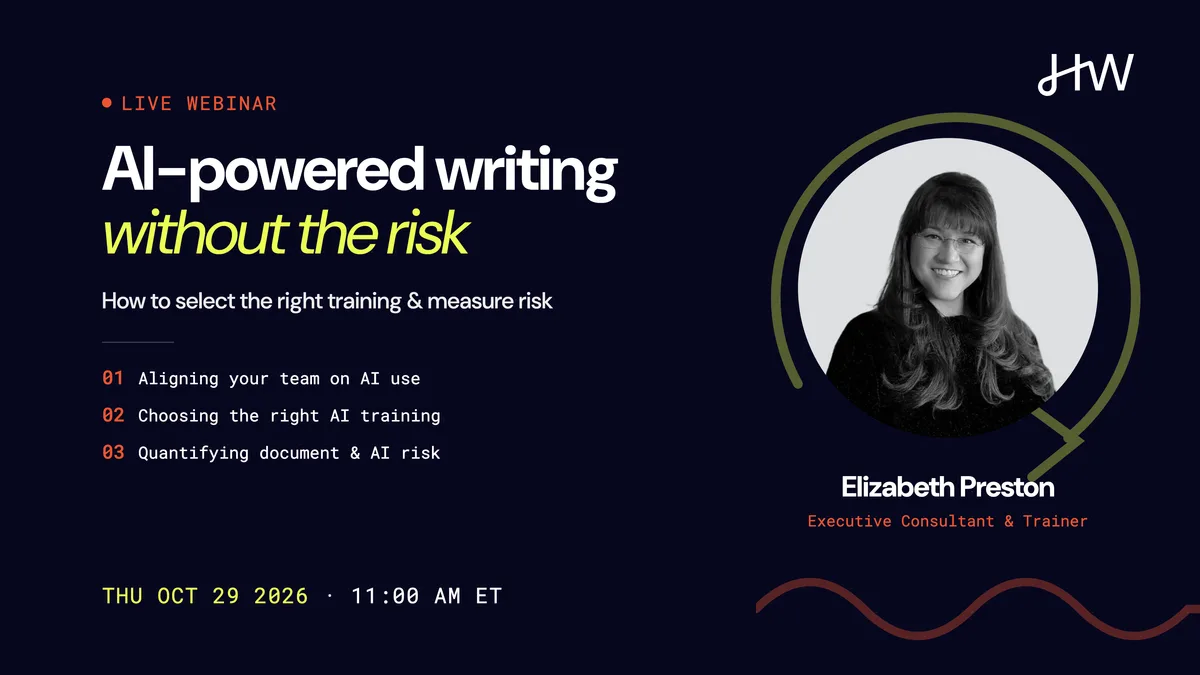
Live sessions from the Hurley Write team. Save your seat.
Start with the PROS Readability Risk Assessment®, or bring us in to run a workshop built on your own documents.